

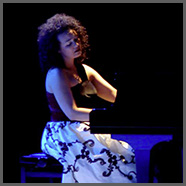
Brazilian pianist Catarina Leite Domenici has an active career as a performer, teacher and researcher. She is recognized as a leading performer of new music in Brazil. For over two decades she has collaborated with several composers in recordings and premieres at contemporary music festivals and concerts in Brazil, Europe, the USA, and Central America. Brazilian music critic Juarez Fonseca praised her solo CD “Porto 60” as “more than a record – it is a reference”. Produced with a grant from the City of Porto Alegre, “Porto 60” received two Açorianos Prize for best classical CD e best instrumentalist. Her recordings of chamber works have received prizes from the São Paulo Art Critics Association and the Açorianos Prize. She holds a Master and a Doctoral degree in Music Performance from the Eastman School of Music, where she was awarded the prestigious Performer’s Certificate and the Lizzie Teege Mason Award. She was twice the recipient of a full scholarship from the Brazilian Government Agency CNPq to pursue graduate studies. During 2008-2009 she was a post-doctoral fellow at the University at Buffalo researching composer-performer collaboration. Domenici is a Piano Professor at the Universidade Federal do Rio Grande do Sul in Porto Alegre, Brazil, where she teaches at the graduate and undergraduate levels. She has served on the faculty of the Chautauqua Music Festival, Curso Internacional de Verão de Brasilia (Civebra), Eastman Community Music School, University at Buffalo, Nazareth College, and the Finger Lakes Community College. As a researcher, she has published articles on music and cognition, and presented papers on composer-performer collaboration in symposiums in Italy, England, Sweden, Portugal, Brazil, and Singapore. Domenici is a founding member and the first president of the Brazilian Association for Musical Performance (ABRAPEM).
I was thrilled to be invited to participate in this wonderfully generous creative project, and proud to be the first woman to contribute to it. I view my participation as a letter to a long-time dear friend, a response to Edson's beautiful 'spark'. As soon as I listened to Edson's track, a melody appeared in my mind. Being the first to contribute to a new trunk, I felt the responsibility to come up with a kind of harmonic structure and to throw in some ideas to stimulate further dialogue with fellow musicians down the line. Aware of the collaborative character of the project, my main concern was to find a balance between too little and too much. To leave plenty of room for other voices to join in, while giving Edson a response matching the impact his ‘spark’ had on me. The track was recorded at home on a Roland Digital Piano (HP505) with the generous assistance of James Correa.
